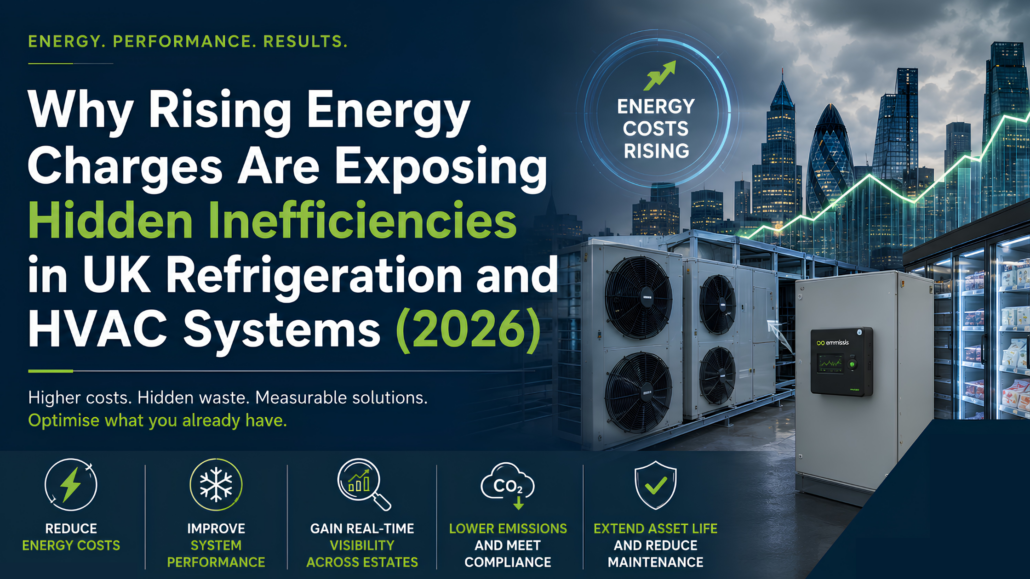
Why Rising Energy Charges Are Exposing Hidden Inefficiencies in UK Refrigeration and HVAC Systems (2026)
In 2026, UK businesses are facing a difficult reality.
Energy prices may have stabilised compared to the volatility of recent years, but the structure of energy costs is changing and for many organisations, the impact is just as significant.
Fixed charges, network costs, and operational inefficiencies are now driving bills as much as consumption itself. For energy-intensive sectors such as retail, food production, logistics, and hospitality, this is creating a new pressure point:
It’s no longer just about how much energy you use, it’s about how efficiently your systems actually operate.
And in most commercial estates, there is still significant hidden inefficiency in plain sight.
Refrigeration is still the biggest hidden cost driver
Across supermarkets, cold storage facilities, and food distribution networks, refrigeration remains one of the most energy-intensive systems in operation.
Industry analysis shows that cooling systems can account for a major proportion of total site emissions and electricity consumption, with some estimates suggesting it dominates operational energy use in food retail environments.
The challenge is that refrigeration systems are:
- Running continuously, 24/7
- Highly sensitive to voltage and load variation
- Often controlled in isolation from wider energy strategy
- Rarely optimised at system level after installation
This means inefficiencies accumulate silently over time — increasing cost, carbon output, and mechanical strain.
Why 2026 is different: energy costs are now structurally higher
Recent changes in UK energy pricing have shifted the burden away from just unit rates.
Businesses are now increasingly affected by:
- Standing charges and fixed network costs
- Higher infrastructure and distribution charges
- Carbon reporting and compliance pressure
- Increased volatility in commercial tariffs
For energy-intensive operations, this means efficiency improvements now deliver higher financial impact than ever before.
Even small percentage reductions in consumption can translate into meaningful annual savings at scale.
The overlooked issue: systems are not operating optimally
Most commercial buildings are not inefficient because of outdated equipment, but because of how existing systems perform under real-world conditions.
Common issues include:
1. Voltage inefficiency
Incoming electrical supply often fluctuates outside optimal operating ranges, leading to unnecessary energy draw and increased equipment stress.
2. Refrigeration over-consumption
Cooling systems frequently operate harder than required due to suboptimal cycling, control drift, and load imbalance.
3. HVAC inefficiency at scale
Heating and cooling systems are often not synchronised across multi-site estates, leading to inconsistent performance and wasted energy.
4. Lack of system-wide visibility
Many organisations still rely on fragmented monitoring tools, making it difficult to identify where inefficiencies originate.
The result: wasted energy that businesses are already paying for
The key issue is not theoretical inefficiency, it is measurable cost leakage.
In large estates, especially across retail and food sectors, small inefficiencies compound across:
- Multiple refrigeration units
- HVAC systems per site
- Hundreds or thousands of locations
- Continuous 24/7 operation
This creates a persistent baseline of avoidable energy consumption that directly impacts operating margins.
What leading organisations are now doing differently
Forward-thinking businesses are moving away from reactive energy management and towards system-level optimisation and verification.
This includes:
- Optimising voltage supply to reduce unnecessary energy draw
- Improving refrigeration performance without replacing core assets
- Deploying monitoring systems that provide real-time visibility across estates
- Verifying savings rather than estimating them
- Treating energy efficiency as an operational discipline, not a facilities task
The focus is shifting from monitoring consumption to actively reducing demand at source.
How Emmissis helps businesses respond
At Emmissis, we specialise in helping organisations reduce energy consumption and improve system performance through engineered optimisation technologies.
Our approach focuses on improving the efficiency of existing infrastructure, including:
- Electrical and voltage optimisation to reduce wasted energy
- Refrigeration system performance improvements across commercial environments
- Energy monitoring and verification platforms to track real savings
- Estate-wide visibility tools for multi-site operations
Rather than replacing infrastructure, we help businesses unlock efficiency from what they already have in place.
Why this matters now
Energy efficiency is no longer just a sustainability initiative.
In 2026, it is directly linked to:
- Operational cost control
- Asset longevity and maintenance reduction
- Carbon reporting compliance
- Competitive advantage in high-cost energy markets
Businesses that can reduce consumption without disrupting operations are gaining a measurable advantage.
Those that cannot are absorbing increasing costs into already tight margins.
The future of energy performance is optimisation, not consumption tracking
The next stage of energy management is not about seeing usage more clearly.
It is about reducing it intelligently, continuously, and at system level.
As energy costs remain structurally high and regulatory pressure increases, the organisations that succeed will be those that treat energy efficiency as a core operational strategy — not a reporting exercise.
How Emmissis can help
Emmissis works with organisations across the UK to identify inefficiencies in electrical, refrigeration, and HVAC systems and deliver measurable reductions in energy consumption through proven optimisation technologies.
If your organisation is looking to reduce operational waste and improve energy performance across its estate, we can help you take control of that process.